AQL Standards
ANSI/ASQ Z1.4 vs ISO 2859-1: What Is the Same, What Is Different, and What to Write in Your PO
American buyers usually write “ANSI/ASQ Z1.4” in their purchase orders. European and Asian buyers usually write “ISO 2859-1”. Factories in China work with both, and our own reports print the standard the client asked for. So which one is right, and does the choice change the result of an inspection? For a normal pre-shipment inspection the short answer is: the numbers are the same. This guide explains why, where the two standards really differ, what the new 2026 edition of ISO 2859-1 changed, and how to read the sampling section of a report, using pages from real SSTI reports.
- Where Z1.4 and ISO 2859-1 come from, and which parts are identical
- The real differences: switching rules, reduced inspection and the 2026 edition
- Three worked examples from SSTI reports, including a lot that failed on minor defects
- The “arrows” in the tables, and what AQL does not promise
- A sampling clause you can copy into your purchase order
One Family Tree
Both standards descend from the same document: the US military standard MIL-STD-105, whose last version, 105E, was cancelled in 1995. ANSI/ASQ Z1.4 is the American civilian version; its current edition is Z1.4-2003, reaffirmed in 2018. ISO 2859-1 is the international version. For more than twenty-five years the edition in use was ISO 2859-1:1999 with an amendment from 2011. In January 2026 ISO published a third edition, ISO 2859-1:2026, which replaces both. ASQ has said it intends to revise Z1.4 in the light of the new ISO edition, so Z1.4 may change too.
Both are standards for inspection by attributes: each piece is judged conforming or nonconforming, and defects are counted. If you measure a characteristic and judge the lot on the average and spread of the readings, you are in a different family: ANSI/ASQ Z1.9 in the United States and ISO 3951-1 internationally.
What Is the Same
For everyday buyer inspections, the parts that matter are the same in both standards:
- Inspection levels. Three general levels (I, II and III) and four special levels (S-1 to S-4). Level II is the default when nothing else is agreed.
- Sample size code letters. The lot size and the inspection level give a code letter, from A to R, and each letter has a fixed sample size.
- Normal single sampling plans. For each code letter and AQL, the table gives an accept number (Ac) and a reject number (Re). If the number of defects found is at or below Ac, that defect class is accepted; at or above Re, it is not.
- The AQL series. The same preferred values: 0.65, 1.0, 1.5, 2.5, 4.0, 6.5 and so on.
| Lot size (pcs) | Special S-4 | Level I | Level II | Level III |
|---|---|---|---|---|
| 281 – 500 | 13 (E) | 20 (F) | 50 (H) | 80 (J) |
| 501 – 1,200 | 20 (F) | 32 (G) | 80 (J) | 125 (K) |
| 1,201 – 3,200 | 32 (G) | 50 (H) | 125 (K) | 200 (L) |
| 3,201 – 10,000 | 32 (G) | 80 (J) | 200 (L) | 315 (M) |
| 10,001 – 35,000 | 50 (H) | 125 (K) | 315 (M) | 500 (N) |
| 35,001 – 150,000 | 80 (J) | 200 (L) | 500 (N) | 800 (P) |
| 150,001 – 500,000 | 80 (J) | 315 (M) | 800 (P) | 1,250 (Q) |
Normal inspection, single sampling. The sample size for a given AQL can still move up or down a row because of the arrows in the table; see below.
Where the Standards Really Differ
The differences sit in the parts of the standards that deal with a continuing series of lots from the same supplier, not with a single lot:
- Switching rules. Both standards start on normal inspection, switch to tightened inspection when 2 out of 5 or fewer consecutive lots are not accepted, return to normal after 5 consecutive lots are accepted on tightened, and stop inspection altogether if 5 lots are not accepted while on tightened.
- Going from normal to reduced inspection. Z1.4 uses “limit numbers”: the last 10 lots must have been accepted and the total number of defects in them must be under a limit from a table, together with steady production and the approval of the responsible authority. ISO 2859-1 replaced the limit numbers with a running “switching score” in 1999.
- Reduced inspection plans. In the 1999 edition ISO changed the reduced plans so that there is no gap between the accept and reject numbers. Z1.4 still has the gap, with a rule for lots that fall into it. Reduced inspection is therefore where the two tables actually give different answers.
- Fractional acceptance numbers. ISO 2859-1 offers optional plans with fractional accept numbers for small samples.
- The 2026 edition. ISO 2859-1:2026 adds skip-lot inspection as a further step in the switching system, moves the operating characteristic curves into an annex that explains how to calculate them, and revises the tables for easier use. It also makes clear that a “supplier” can be an internal department.
Why a One-Off Inspection Gives the Same Result Under Both
Switching rules need a history: a record of consecutive lots from the same supplier, inspected under the same plan. Most buyer inspections in China are not run that way. Each order is inspected on its own, under normal inspection, at the level and AQL in the purchase order. In that situation the two standards give the same sample size and the same accept and reject numbers, so a pre-shipment inspection does not pass under one and fail under the other.
The choice starts to matter in long-running programmes, where a buyer ships many lots a year from one factory and wants to use tightened or reduced inspection. If that is you, cite one standard, with its edition, and write down how the switching history is recorded and who decides a switch. Otherwise the factory and the inspection company may each assume a different rule. For a one-off order, name the standard your customer or your quality manual uses, and do not spend time arguing about it.
The online booking form in SSTI's client portal works out sample sizes and accept numbers from the ISO 2859-1 tables for normal single sampling. Because the normal plans are the same, a buyer who writes Z1.4 in the purchase order gets the same numbers.
Example 1: A Production Inspection That Failed on Minor Defects
This is the workmanship section of a during-production inspection (DUPRO) of plastic water bottles. The order was 45,252 pieces; at the time of the visit, 27,000 were finished. Only goods that exist can be sampled, so the lot size is the quantity presented: 27,000 pieces.
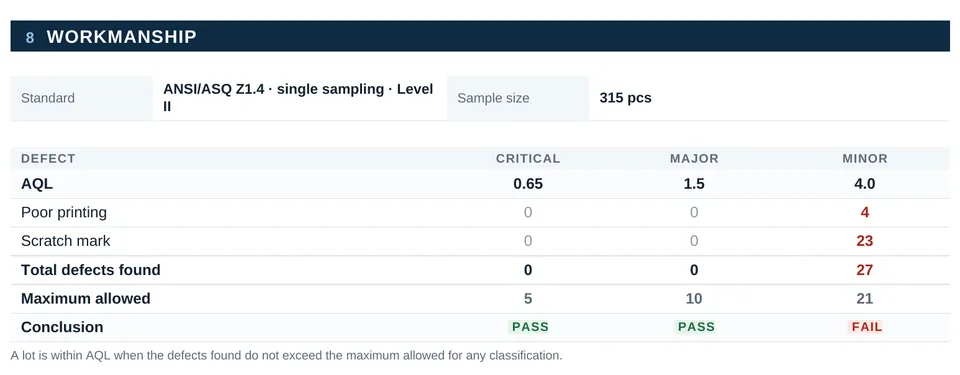
- 27,000 pieces at level II gives code letter M: a sample of 315 pieces.
- The client chose AQL 0.65 for critical, 1.5 for major and 4.0 for minor defects. For code letter M the table gives accept numbers of 5, 10 and 21.
- The inspector found no critical and no major defects, but 27 minor ones (4 printing faults and 23 scratches). 27 is above 21, so the minor class failed, and with it the workmanship result.
Two details are worth noticing. First, had the full order of 45,252 pieces been there, the code letter would have been N and the sample 500 pieces, with different accept numbers. The sample follows the lot, not the purchase order. Second, the failure came from one defect type, scratches, which points straight at a handling problem on the line. Finding it during production gives the factory time to fix it before the rest is made. What to do next is covered in what to do when an inspection fails.
Example 2: A Re-Inspection That Passed
The second example is a re-inspection of 4,000 bamboo bath mats, all packed in 400 cartons.
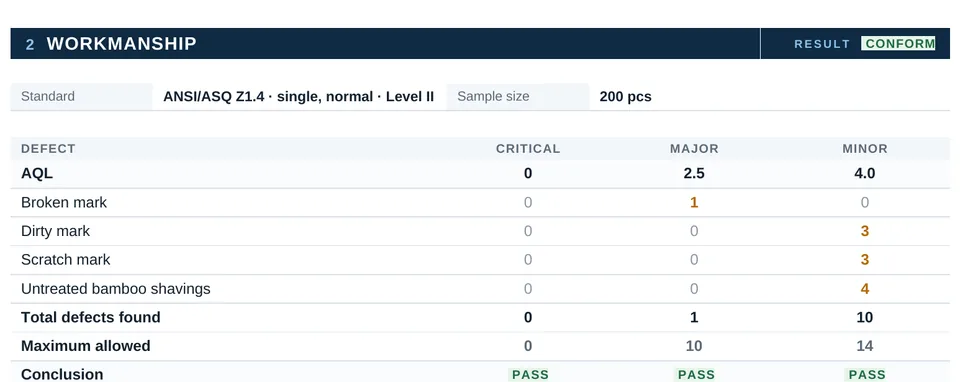
- 4,000 pieces at level II gives code letter L: 200 pieces.
- At AQL 2.5 and 4.0 the accept numbers are 10 and 14.
- Critical defects were set to “0”. That is not a value in the tables. It is a buyer convention meaning that a single critical defect fails the lot, whatever the sample size.
- Found: 0 critical, 1 major, 10 minor. Every class is within its limit, so the workmanship result is “conform”.
Passing on workmanship did not close the report. The same inspection left seven points open, among them a carton drop test the factory refused and a mat length out of tolerance. A sampling result covers the defects counted in the sample, nothing more.
Example 3: Special Levels for Tests
Tests such as a tape test, a pull test or a barcode scan take longer than a visual check, and some damage the piece. They are therefore run on a smaller sample drawn with a special inspection level. In the same re-inspection, most tests used level S-4.
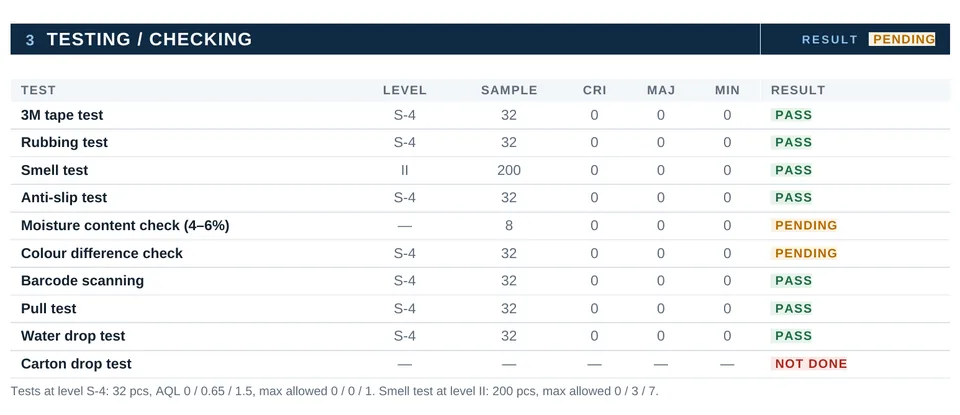
- 4,000 pieces at S-4 gives code letter G: 32 pieces.
- The test AQLs were 0, 0.65 and 1.5, so the maximum allowed was 0, 0 and 1.
- The smell test, which is quick and does not damage the product, was run on the full level II sample of 200 pieces.
Note the major class: AQL 0.65 on 32 pieces allows no defect at all. That is the effect of an arrow in the table, explained next. Which tests are worth asking for is covered in on-site tests during inspection.
How these sections fit into a full report is shown in how to read a pre-shipment inspection report, and what a visit during production covers is explained in during-production inspection in China.
The Arrows: When the Sample Size Changes With the AQL
The single sampling table does not have a plan in every cell. Where there is none, an arrow points up or down to the nearest plan, and you use that plan's sample size and accept number. This is the most common source of confusion when buyers check a report.
| Sample size (code letter) | AQL 1.5 | AQL 2.5 | AQL 4.0 |
|---|---|---|---|
| 50 (H) | 2 / 3 | 3 / 4 | 5 / 6 |
| 80 (J) | 3 / 4 | 5 / 6 | 7 / 8 |
| 125 (K) | 5 / 6 | 7 / 8 | 10 / 11 |
| 200 (L) | 7 / 8 | 10 / 11 | 14 / 15 |
| 315 (M) | 10 / 11 | 14 / 15 | 21 / 22 |
| 500 (N) | 14 / 15 | 21 / 22 | ↑ use 315: 21 / 22 |
| 800 (P) | 21 / 22 | ↑ use 500: 21 / 22 | ↑ use 315: 21 / 22 |
Take an order of 120,000 pieces at level II. The code letter is N, 500 pieces. For AQL 2.5 that gives accept 21, reject 22. For AQL 4.0 the cell has an arrow pointing up, to code letter M: the minor class is judged on 315 pieces, again with accept 21. In practice the inspector draws the larger sample and records which pieces count for which class. On SSTI's booking page each defect class is shown with its own sample size and accept number, arrows included, so you can check the report against it.
A report that shows 500 pieces and “21 allowed” for both major and minor defects is therefore not necessarily wrong, but you should know which rule was used. If you prefer the stricter reading, judging minor defects on all 500 pieces with accept 21, say so in your checklist.
What AQL Does Not Promise
AQL stands for acceptance quality limit. Both standards define it as the worst average defect rate that is still tolerable when a continuing series of lots is submitted. It is a setting of the sampling scheme. It is not a target, and it is not a promise about any single lot:
- AQL 2.5 does not mean that 2.5% defective goods are “acceptable”. A lot with a higher defect rate can pass by chance, and a lot with a lower rate can fail.
- Z1.4 states that the AQL does not give the supplier the right to knowingly supply nonconforming product.
- Defective pieces found in the sample are defective whatever the result. They should be replaced or repaired, and a good report says so.
Choosing the right AQL for each defect class depends on how you classify defects. Our guide to critical, major and minor defects covers that, and the AQL guide for importers explains the risk on both sides.
What to Write in Your Purchase Order
Whichever standard you choose, the clause should leave nothing to interpretation. A clause we see work well:
Quality inspection by attributes according to ISO 2859-1:2026 (or ANSI/ASQ Z1.4-2003 (R2018)), single sampling, normal inspection, general inspection level II. Acceptance quality limits: critical 0 (no critical defect accepted), major 2.5, minor 4.0. The lot is the quantity presented for inspection; at least 80% of the order must be finished and packed for a pre-shipment inspection. Tests listed in the attached checklist are carried out at special level S-4 unless stated otherwise. Defects are classified according to the attached defect list. A lot not accepted on any defect class is not to be shipped without the buyer's written approval; defective pieces found in the sample are replaced.
Adjust the level and AQLs to the product and the supplier: level III or a lower AQL for a new supplier or a product that has failed before, level I for a simple repeat order with a clean record. More clauses worth adding are in inspection clauses for a China purchase order, and the AQL calculator gives the sample size and accept numbers for any quantity.
Sources
- ISO — ISO 2859-1:2026, Sampling procedures for inspection by attributes, Part 1 (third edition, replaces ISO 2859-1:1999 and Amd 1:2011)
- Quality Magazine — Third revision of ISO 2859-1
- Quality Magazine — A brief history of ANSI/ASQ Z1.4
- ANSI webstore — ANSI/ASQ Z1.4-2003 preview pages (switching procedures, AQL definition)
- ISO — ISO 3951-1, sampling procedures for inspection by variables
Standards change. Check the edition named in your contract before relying on any table value.
Set your sampling plan when you book
Choose the inspection level and AQL for each defect class; the sample size and accept numbers are calculated as you type.
Book an inspection