Factory Audit
How a Factory Audit Is Scored, and What a 65-Point “C” Really Tells You
A factory audit report can run to a dozen pages of photos and notes. Most buyers read one line: the score. That is reasonable, as long as you know how the score is built and what it leaves out. This guide explains how SSTI scores a factory audit, what the grades A to E mean for an order, and how to read a real result. Our example is an anonymised audit of a faucet manufacturer in Zhejiang that scored 65.4 out of 100: a grade C, approved, with two weak areas a buyer should not ignore.
- The 28 checkpoints and five categories behind the score
- How each checkpoint is rated, and why the categories carry different weight
- Grades A to E and what we advise for each
- A real C-grade audit, read line by line
- What a score cannot tell you
Why Score an Audit at All?
An audit is a judgement, and judgements are hard to compare. A score turns the auditor's findings into something you can use: two candidate suppliers audited a month apart can be compared side by side; a re-audit a year later shows whether a factory has improved or slipped; and a minimum grade can be written into your supplier approval procedure. The score does not replace the findings. It tells you where to look in them.
Five Categories, 28 Checkpoints
The audit checklist has 28 checkpoints in five categories. In the report below they were weighted as follows:
| Category | Checkpoints | Points | Examples of what is checked |
|---|---|---|---|
| 1. Operations and capacity | 4 | 15 | Business policy and objectives, training, customer and market performance, inventory management |
| 2. Development and technology | 4 | 20 | Product development capability, development process control, new product launch, technical documents |
| 3. Quality management | 13 | 45 | Purchasing control, incoming and finished-goods inspection, process control, test equipment, reliability testing, corrective action, change management, document control, 5S, packing |
| 4. Delivery and production management | 4 | 15 | Production planning, lead-time control, customer satisfaction, production efficiency |
| 5. Ethics and workplace safety | 3 | 5 | No child labour, safe working environment, first aid and emergency preparedness |
Quality management carries almost half the points, because it decides whether good samples turn into good bulk production. Development and technology matters most when the factory has to make your design, not its own catalogue product. Ethics and safety carries few points, but it contains items that override the score altogether; more on that below.
How Each Checkpoint Is Rated
Each checkpoint has written rating criteria, so that two auditors reach the same result. The rating follows one simple logic:
- Fully in place: written down and clearly practised; the auditor saw the evidence on site, such as records, signed forms or the process running.
- Partly in place: it exists, but is not written down, not complete or not done consistently.
- Not in place: not seen, or no evidence provided.
The ratings are converted into points and added up to a score out of 100. The rule that matters most to a buyer is the last one: no evidence means no points. A factory manager saying “we check every batch” earns nothing until the inspection records are on the table.
Grades A to E
| Grade | Score | Decision | What we usually advise |
|---|---|---|---|
| A – Excellent | 85 – 100 | Approved | Normal pre-shipment inspection; re-audit every one to two years or when something changes |
| B – Good | 75 – 84 | Approved | Pre-shipment inspection on every order; follow up the weak points at the next visit |
| C – Acceptable | 65 – 74 | Approved | Agree corrective actions on the weak categories; add a during-production inspection on the first orders |
| D – Needs improvement | 55 – 64 | Approved with an improvement plan | Start with a small order, inspect during production and before shipment at a stricter level, and re-audit within six months |
| E – Re-audit | Below 55 | Not approved | Do not place the order until the factory has corrected the findings and passed a re-audit |
Grades A to D can be approved; grade E needs a re-audit. The advice in the last column is a starting point. A grade D factory making a simple product may be lower risk than a grade B factory making something technical and safety-related.
A Real Example: 65.4 Points, Grade C
Here is the summary of an audit carried out in August 2026 at a faucet manufacturer in Taizhou, Zhejiang. The company name and other identifying details have been removed.
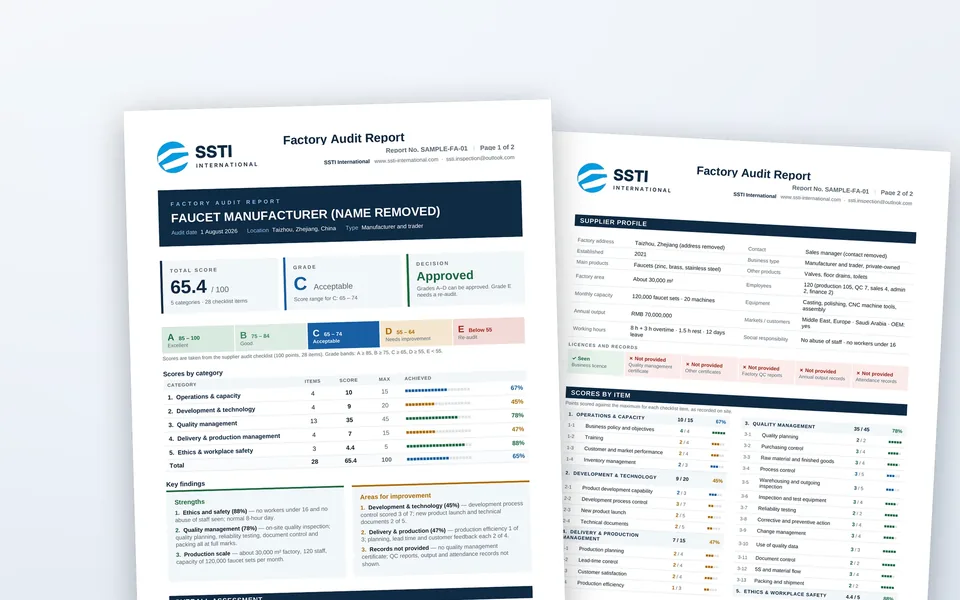
| Category | Score | Maximum | Achieved |
|---|---|---|---|
| Operations and capacity | 10 | 15 | 67% |
| Development and technology | 9 | 20 | 45% |
| Quality management | 35 | 45 | 78% |
| Delivery and production management | 7 | 15 | 47% |
| Ethics and workplace safety | 4.4 | 5 | 88% |
| Total | 65.4 | 100 | Grade C |
The profile: about 30,000 m² of factory space, 120 employees, of whom 7 work in quality control, 20 machines for casting, polishing, CNC machining and assembly, and a stated capacity of 120,000 faucet sets a month. The business licence was seen. A quality management certificate, the factory's own QC reports, output records and attendance records were not provided; the factory said they contain customer information.
What the 65.4 hides
A total of 65.4 sounds like a middling factory. The category scores tell a sharper story:
- Quality management is solid (78%). On-site inspection, quality planning, reliability testing, document control and packing all scored full marks. If you are buying a product the factory already makes, this is the category that matters most, and it is the strongest.
- Development is weak (45%). Development process control scored 3 of 7, new product launch and technical documents 2 of 5 each. If you plan a new design, expect slow sampling and specifications that drift between samples and bulk. Insist on a signed golden sample and a pre-production check.
- Delivery is weak (47%). Production efficiency scored 1 of 3; planning, lead time and customer feedback 2 of 4 each. Build buffer into your delivery date and book a during-production inspection, so you see progress rather than hearing about it.
- Missing records cost points and leave questions. Without QC reports there is no proof that the inspections described actually happen. Ask for the records again with customer names blacked out; a factory that refuses even that is telling you something.
The report also records working hours of 8 hours plus 3 hours of overtime. Chinese law sets a standard of 8 hours a day and 40 hours a week, and limits overtime to 3 hours a day and 36 hours a month. Three hours every working day would be far above the monthly limit. Whether that is a peak or the normal routine is worth asking, because long overtime is linked to fatigue, defects and staff turnover.
So the C is a fair grade, but two buyers could read it very differently. For a repeat order of a catalogue faucet, it is a reasonable supplier with good quality control. For a new design on a tight deadline, it is a risk in exactly the two areas that matter.
What a Score Cannot Tell You
- Some findings override the score. Child labour, forged certificates, a hidden second factory or production subcontracted without your knowledge are not “minus four points”. They end the assessment. Our auditors report child labour immediately, whatever the total. See warning signs of unauthorised subcontracting.
- A score is a snapshot. It shows the factory on the audit day. Quality can fade after the first orders, which is why audits are followed by inspections. See how to prevent quality fade.
- A good factory can make a bad batch. An audit approves the supplier; only an inspection approves the goods. See what a factory audit should tell a buyer.
- Certificates need checking. An ISO 9001 certificate on the wall can be verified in IAF CertSearch, the International Accreditation Forum's database of accredited certificates. A missing certificate is not a failure in itself, but a certificate that cannot be verified is a red flag.
Using the Score in Practice
- Set a minimum grade for new suppliers, for example C, and require a corrective-action plan for any category below 50%.
- Compare categories, not only totals, when choosing between two factories. Match the strong categories to what your order needs.
- Re-audit after major changes: a move, new ownership, a new product line or a run of failed inspections.
- Combine the audit with the right inspections: a pre-production check for new designs, a during-production inspection where delivery is weak, and a pre-shipment inspection on every order.
Before the audit itself, a few checks can be done from your desk; see how to verify a new supplier in China and trading company or factory.
Sources
- Labour Law of the People's Republic of China (English translation, CECC): minimum working age, overtime limits
- State Council Provisions on Working Hours of Employees (1995): 8 hours a day, 40 hours a week
- ISO — How to verify an accredited certification (IAF CertSearch)
Laws change. Check the current official text before relying on any requirement.
Audit a supplier before you commit
Book a factory audit online; the report gives a score, a grade and the evidence behind every checkpoint.
Book a factory audit