Kitchenware
Kitchenware and Food Contact Product Inspection in China
Kitchenware and other products that touch food are regulated for what they release into food, not only for how they look and work. That makes the split between on-site inspection and laboratory testing especially important. An inspector cannot measure chemical migration in a factory. What an inspector can do is check that the materials are the ones that were tested, catch the physical defects customers complain about, and confirm the labelling. This guide covers what that involves for cookware, utensils, containers and drinkware.
- The main food contact rules in the US and EU
- Stainless steel grades, and how to check them
- On-site physical and functional tests for kitchenware
- What must go to a laboratory
The Rules in Brief
In the United States, materials that contact food are regulated by the FDA, with the main requirements for food contact substances in Title 21 of the Code of Federal Regulations. In the European Union, the framework is Regulation (EC) No 1935/2004, which requires that materials do not transfer substances to food in amounts that endanger health or change the food unacceptably. Specific measures apply to some materials, such as Regulation (EU) No 10/2011 for plastics, which also requires a written declaration of compliance. Germany's LFGB is often cited by buyers selling there. Since late 2024 the EU has also restricted bisphenol A and other hazardous bisphenols in food contact materials under Regulation (EU) 2024/3190, with the main transition period ending on July 20, 2026.
All of these are proven by documents and laboratory testing. The inspection protects that work by checking that the production matches what was tested.
Stainless Steel: 304 vs. 201
Grade 304 stainless steel (often sold as 18/8) contains about 18% chromium and 8% nickel. Grade 201 replaces much of the nickel with manganese, which makes it cheaper and less resistant to corrosion. The two look the same when new. A product specified in 304 and made in 201 may rust or pit in use, especially with salt and acidic foods.
A magnet is not a reliable test, because 304 can become slightly magnetic after forming. The practical on-site options are:
- Documents. The steel supplier's material certificate for the batch, checked against the grade in the contract.
- Handheld XRF. An XRF analyser measures nickel, chromium and manganese, so it can tell 304 from 201 quickly. It is a screening method, not a certified test.
- Chemical spot tests. Test solutions that react to nickel or molybdenum give a fast indication on site.
- Laboratory analysis. For a definitive result, production samples go to a lab.
The same principle applies to any material grade, as our steel grade substitution case shows.
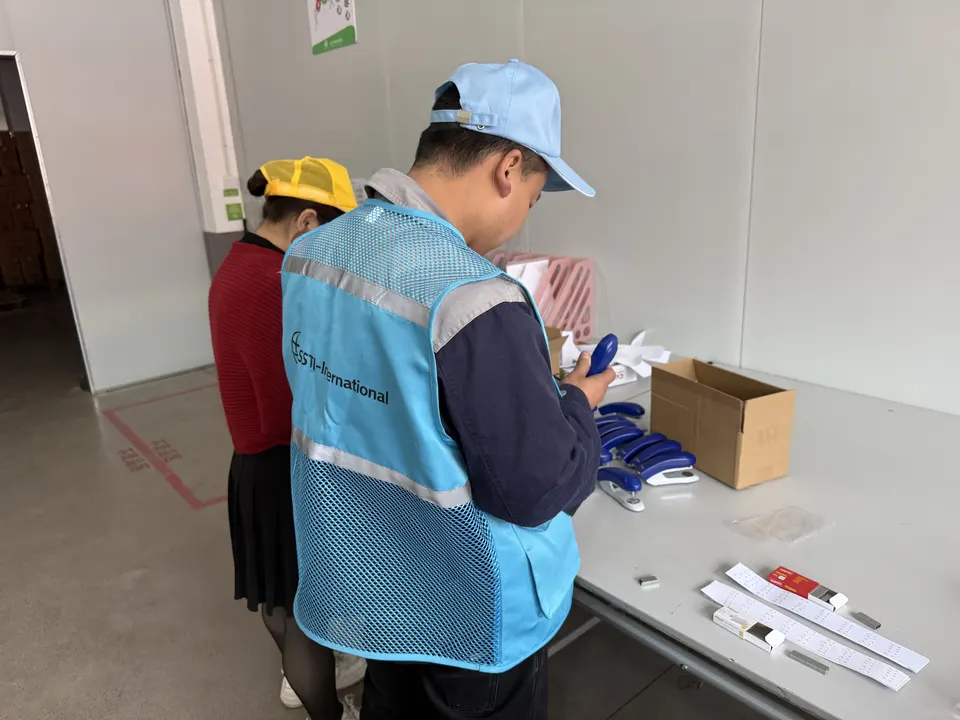
On-Site Tests for Kitchenware
- Coating adhesion. A cross-hatch tape test on non-stick and painted surfaces shows whether the coating will lift.
- Handle strength. Handles and knobs are checked for secure fixing, and given a simple load or pull check where the checklist specifies one.
- Leak test. Containers, bottles and vacuum flasks are filled, closed and turned over to check the seal.
- Hot water and thermal checks. Where specified, products are filled with hot water to check for leaks, warping or cracking, and vacuum flasks for heat retention against the claim.
- Odour and appearance. Silicone and plastic parts are checked for strong odour and discolouration, which can indicate a different or poorly cured material.
- Fit and function. Lids fit, seals seat properly, measuring marks are correct, and non-stick surfaces are free of scratches and bare spots.
More on how these tests are set up is in our guide to on-site inspection tests.
What Must Go to a Laboratory
| Question | Checked on site | Needs a lab |
|---|---|---|
| Right material? | Material certificates, XRF screening of stainless grade, odour and appearance of plastics and silicone | Definitive material analysis |
| Safe for food? | — | Overall and specific migration, heavy metals, restricted substances such as bisphenols and PFAS |
| Coating durable? | Cross-hatch adhesion, visual defects | Abrasion and long-term performance |
| Works and seals? | Leak, fit, hot water and function checks | Heat retention and lifetime tests to a standard |
| Documented? | Labels, food-contact symbol where used, instructions vs. artwork | Declaration of compliance supported by test reports |
Ask the inspector to select and seal production samples for the lab from the packed goods, so the factory does not choose what is tested. Then a passing lab report describes the goods you are actually shipping.
When to Inspect
Material checks belong early. An initial production check confirms the steel, coating and plastic before most units are made. A pre-shipment inspection then covers workmanship, function tests, labels and packing on the finished goods, sampled under AQL. See our inspection services for how SSTI handles both.
Importing kitchenware from China?
SSTI checks materials, coatings, seals and labelling, and can select and seal production samples for your lab.
Talk to SSTI